
BOP Federal Release Paths
The Federal Bureau of Prisons operates a nationwide prison system for federally sentenced people. Its relevance to Giles begins only when a person entered federal prison custody. NRVRJ reports that federal inmates are among its population, but local regional-jail holding can occur before BOP designation or under another federal arrangement. A person moved from NRVRJ by the U.S. Marshals Service may be in transit, sent to a BOP institution, taken to court, or transferred to another sovereign.
A BOP record with a past Release Date and Location shown as “RELEASED” means the person is no longer in BOP custody. It does not establish that federal supervised release ended or that state, local, or immigration custody is absent. Halfway placement and other transitional statuses also need the exact official label. Use the federal docket and receiving-agency record when the path is unclear.
Confirm a BOP Release
Search the BOP Inmate Locator by BOP, FBI, DCDC, or INS number when a reliable identifier is available. Name search offers age, race, and sex refinements. Match the returned register number and identity details. The public locator covers federal inmates released after 1982, so older incarceration requires National Archives research.
- Determine that the matter involved federal prison, not only an NRVRJ or USMS hold.
- Search by the strongest identifier or refine a name search carefully.
- Read the exact Release Date and Location or status fields.
- Check the federal court docket for the order and any supervised release term.
- Follow ICE, VADOC, a local jail, or another custodian if a detainer or transfer appears.
The Giles County release search is the proper starting point for a local booking. A regional jail Release Date can close NRVRJ custody before federal prison begins. Conversely, a federal pretrial defendant can leave local holding without ever creating the expected BOP history.
BOP Release Records Contact
The locator is the first public route, while BOP's FOIA process is the records fallback. Ask for the specific federal prison, admission, release, or status record and identify the person by full name, register number, and date of birth when disclosure rules permit. Privacy verification or authorization may be required.
Federal Bureau of PrisonsNationwide federal prison system
Public locator: BOP Inmate Locator
Records route: BOP Freedom of Information Act page
Federal fees and exemptions can apply. A narrow request is more useful than asking BOP to explain every later custody event. BOP controls its own records, not the federal court docket, USMS transport file, ICE detention record, or state and local custody record. Send separate requests to the agency that created each document.
BOP Release Record Fields
The public BOP result can include register number, name, age, race, sex, Release Date, and Location or status. These fields help distinguish people with similar names and place a federal custody event in time. They do not state every court condition, supervision detail, or later hold. “IN TRANSIT” is not community release.
| Field | How to read it |
|---|---|
| Register number | Primary identifier for the federal record |
| Name and descriptors | Identity matching, not proof by name alone |
| Release Date | Past or expected federal custody date as displayed |
| Location “RELEASED” | No longer in BOP custody |
| “IN TRANSIT” | Movement in federal custody, not community release |
BOP warns that a USMS pretrial person can be removed from a facility and later released by a court without BOP receiving a further update. In that circumstance the court order and USMS or holding-facility records carry more weight than a stale locator entry.
BOP Federal Locator Screen
The official federal locator presents both number and name search routes:
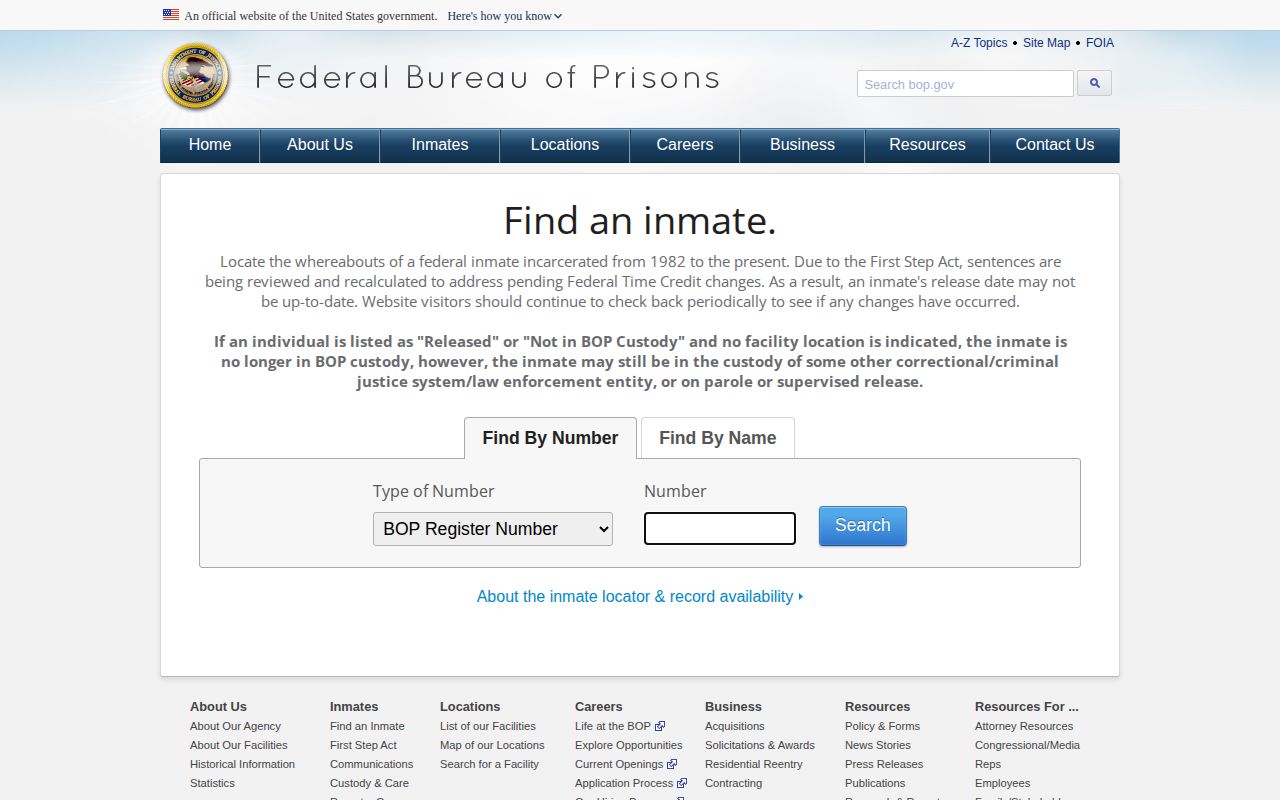
The nationwide screen should be used only after the record trail establishes a federal prison connection. It is not a substitute for the Giles regional jail lookup.
Search accuracy improves with a register number. If only a name is known, use demographic refinements and compare the federal case. Similar names, aliases, and incomplete dates can cause a mismatch. An absent pre-1982 record also falls outside the stated public locator period.
USMS Movement Versus Release
The U.S. Marshals Service manages federal pretrial custody and transport but has no general public released-prisoner locator. A person held at NRVRJ for federal purposes may be moved by USMS without being designated to a BOP prison. The federal court order, NRVRJ record, and receiving facility form the correct chain.
USMS FOIA identifies prisoner processing, population management, and tracking records as possible request subjects, subject to federal exemptions. Ask for a focused date range and event. A federal docket can show that a judge ordered release, but the holding facility or marshals record best establishes when the transfer or departure was carried out.
- Designation
- Assignment to a BOP institution or federal setting.
- In transit
- Movement between federal custody points.
- Supervised release
- Court-ordered community supervision after federal imprisonment.
- Detainer
- A basis for another authority to assume custody.
After BOP Custody Ends
Federal supervised release is imposed by the sentencing court and ordinarily administered through federal probation. It is not BOP prison custody. A BOP “RELEASED” record can coexist with active supervision. The judgment and later court docket describe the term and any modification or revocation.
ICE pickup is another distinct possibility. A noncitizen may leave BOP or NRVRJ directly for civil immigration custody. State or local warrants can also produce a transfer. Search the receiving system and describe only the custody that the source proves.
For a person with no BOP match, recheck the federal connection. The case may be pretrial, pre-1982, under another name, or never placed in BOP custody. Use the court, USMS, and actual holding facility before concluding that release occurred.
Note: A past BOP date does not establish the end of federal supervision or another agency's custody.
Federal Release Record Chain
A federal judgment states the sentence and supervised release term. The BOP locator supplies the public prison status and date. A BOP release or transfer document records the institution's action. The federal docket can later show modification, revocation, or another court event. None of these alone establishes the absence of a state, local, or ICE hold.
For a person first held at NRVRJ, preserve both bookings. The regional record can show when local holding ended. A later BOP record can show federal imprisonment and its release. If USMS moved the person before BOP designation, request the transport or prisoner-tracking record and review the federal docket. This separates a local jail exit from a federal prison discharge.
Records requests may require the subject's consent, proof of identity, or another legal basis. Ask for existing documents and a defined date range. Do not ask one agency to certify another agency's custody. Federal court copies, BOP records, USMS records, and ICE records each have their own access rules.
Older Federal Release Records
The BOP public locator covers federal inmates released after 1982. For an earlier federal confinement, use National Archives research rather than interpreting no result as no incarceration or no release. Name variations and identifiers matter in old files, so collect the federal court, institution, and date range first.
Some federal defendants never reach a BOP institution. USMS may hold them at a local or contract jail while the case is pending. A court can then release the person without a normal BOP release update. In that situation, the judgment or release order and the holding facility's departure record are the strongest sources.
Federal parole exists mainly in older legal cohorts, while supervised release is a court term used in modern sentencing. Do not use the two labels as synonyms. The exact judgment and supervising authority determine which applies after prison.
BOP records also do not replace victim-notification systems. Virginia Jail VINE concerns participating local and regional jails, while NAAVI covers eligible VADOC notifications. Neither is the federal prison locator. A Giles-related federal case should stay on the BOP, federal court, USMS, and receiving-agency track.
A past federal Release Date should be matched to the correct register number and judgment. A person can have more than one federal or state matter, and one completed sentence does not dispose of another. The Location field describes BOP status, not the full legal history. Save the exact wording and check the docket for a supervised release term.
When another sovereign takes custody, document the handoff. An ICE locator result, state prison record, or local booking supplies the next stage. If no receiving record is public, a focused request may ask BOP or USMS for the transfer destination, subject to lawful limits. That evidence supports “transferred” without prematurely calling the event community release.
BOP's record explanation defines the public locator's release meaning and time scope. When pretrial movement is the missing link, the USMS FOIA page identifies the federal request channel for prisoner tracking records.
Note: BOP's public locator covers federal inmates released after 1982; earlier federal prison records require National Archives research.
Note: A person held locally for USMS may leave NRVRJ without ever producing a standard BOP release record.