
Giles Parole and Probation Differences
Parole and probation both permit a person to live in the community under rules, but their legal sources differ. A Giles Circuit Court judge orders probation. It may replace incarceration, follow a jail or prison term, or be imposed after a suspended sentence. The Virginia Parole Board decides discretionary parole for eligible state prisoners. After a parole release, Virginia Department of Corrections community-corrections officers supervise compliance. A modern sentence may also include post-release supervision even when traditional discretionary parole does not apply.
The distinction affects where to verify the record. A probation term begins with the sentencing order and may be reflected in the Virginia circuit court case system. A parole decision originates with the Board, while active state supervision may appear in the VADOC Inmate and Supervisee Locator. Neither label means final discharge. Release from a prison is one event, and completion of all supervision is another.
| Point | Parole | Probation |
|---|---|---|
| Who authorizes it | Virginia Parole Board for an eligible prisoner | Sentencing court |
| When it applies | After release from institutional custody | Instead of or after incarceration |
| Giles supervision route | VADOC District 16 | District 16 for state probation, or a separate local program if ordered |
| Best source | Board decision, VADOC status, and release record | Court order, VADOC status, and supervising office |
- Parole
- Conditional community release from a parole-eligible prison sentence before final sentence discharge.
- Probation
- Court-ordered community supervision that may replace or follow confinement.
- Discharge
- The formal end of the relevant supervision term, not merely departure from a jail or prison.
- Absconder
- A supervisee alleged to have stopped reporting or left supervision without permission.
Verify Giles Post-Release Supervision
The safest check follows the authority behind the sentence. The VADOC Inmate and Supervisee Locator covers people in VADOC institutions and people under active VADOC probation or parole. Search with at least the first three letters of the first name and the full last name, or use the seven-digit DOC ID. Optional filters include location, race, gender, and age. VADOC states that its data is updated daily, yet it can still be inaccurate or out of date.
A supervisee result is useful affirmative evidence that VADOC authority remains active and that institutional custody on that case has ended. It is not the final word. It does not establish the exact prison gate time, prove completion of every sentence, or rule out another jurisdiction's warrant or hold. A missing result is also inconclusive because a fully discharged person can fall outside the locator's active population.
- Search the VADOC locator by DOC ID when available, then compare the full name, age, and listed location.
- Read the status as current VADOC authority, not as a full account of the criminal case or release.
- Check the Giles court docket for the sentencing, probation, revocation, or discharge order tied to the case.
- Use the official office directory to confirm that District 16 is the assigned state supervision office for Giles.
- Ask the office about the correct administrative contact when a record needs direct confirmation.
Note: The Giles County released inmate search explains the separate NRVRJ release record when the person never entered state custody.
Giles District 16 Supervision
Giles County reports to VADOC Probation and Parole District 16 in Wytheville. The official directory assigns Galax and Bland, Carroll, Giles, Grayson, and Wythe counties to that district. The nearby Radford office is District 28 and is not the listed Giles office. That regional assignment is easy to miss when searching only by distance.
District 16 is an administrative and supervision office, not a jail. Appearance there means the person is subject to VADOC community authority. It does not state that every other case has closed. Staff can route an appropriate inquiry, but Virginia law permits withholding supervision-file details such as risk assessments, case plans, treatment information, and protected addresses under Va. Code § 2.2-3706(B)(6).
Probation & Parole District 16
500 Peppers Ferry Road
Wytheville, VA 24382
(276) 228-5311
Use the current VADOC directory for office information because staff assignments can change.
Giles Local Supervision Boundaries
Not every person released from New River Valley Regional Jail enters VADOC parole or probation. New River Valley Community Corrections and Pretrial Services serves the 27th Judicial District, including Giles. It manages local pretrial supervision and local probation functions. It is separate from VADOC District 16, separate from the Parole Board, and not a public named-person search.
A person may bond out of NRVRJ and report to the regional pretrial program under a Giles court order without ever becoming a VADOC parolee. For that case, the court docket identifies the controlling order and office. The NRVRJ release date can establish when regional-jail custody ended, while the court record explains the conditions that followed. Mixing those systems can lead to a false claim of parole when the actual status is pretrial release.
Note: A Giles court order, not the office's proximity or name, determines whether state or local supervision applies.
Giles Parole Decisions and Release
The Virginia Parole Board decides whether an eligible state prisoner receives parole. Its public-meetings page lists upcoming meeting information and past minutes, but the Board warns that those meetings do not cover every parole-eligible person. Monthly parole decision reports may list a name, DOC number, case type, decision date, grant or denial, reasons or conditions, sentence facts, and member votes.
A grant is not physical release. Current Va. Code § 53.1-136 generally directs VADOC to set release no sooner than 30 business days after receiving notice from the Board chair, subject to an exception. VADOC must still complete the release process, check other authority, and set the actual departure. Confirm the later VADOC status and release record instead of treating the Board vote as the day someone left custody.
Public meeting dates are not a complete named-person interview calendar. The Board's procedure manual divides interview calendars into quarters, and the first interview generally sets the quarter for later review. Virginia law calls for timely review and usually at least annual review, while permitting longer deferrals in limited cases. A monthly decision report is therefore more useful for a published outcome than a meeting calendar is for predicting one person's release.
The Virginia Parole Board site shown here provides the official path to meetings and decisions.
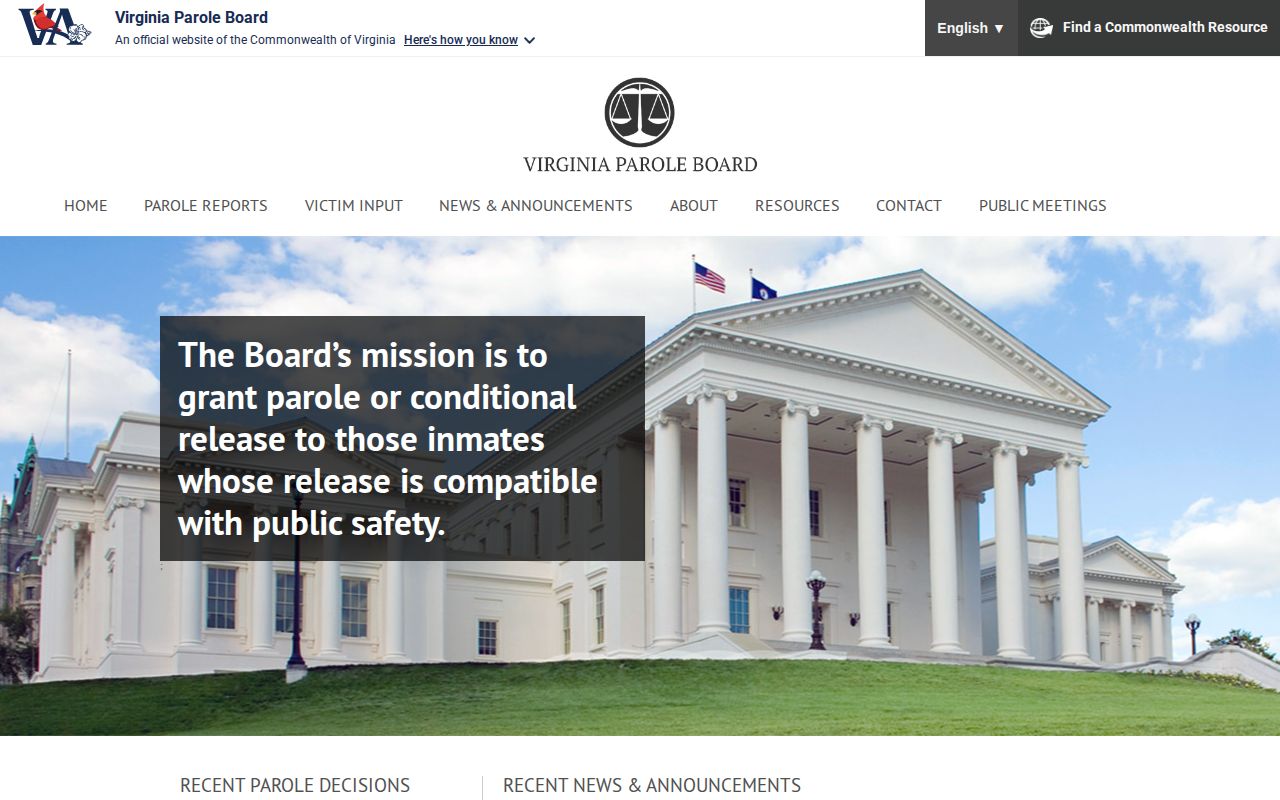
The navigation helps locate a decision source, while VADOC and the release documents establish what happened after that decision.
Giles Supervision Warrants and Absconders
A violation allegation can lead to a probation officer's PB-15 arrest warrant, a court capias, or a Parole Board warrant. A capias is a court order directing law enforcement to take a person into custody. An arrest or revocation process may interrupt community supervision, but the supervising officer, court, or Board determines the legal status.
VADOC's Most Wanted list is selective and statewide. Absence from that page does not prove compliance, discharge, or lack of a warrant. Do not confront anyone based on a listing. VADOC publishes 1-877-896-5764 for tips, and emergencies go to 911. For a Giles-specific claim, use the current VADOC source and the court record rather than copying an old label.
Note: A warrant can change custody status quickly, so pair any online supervision entry with the latest court or agency record.
Giles Reentry After Release
Virginia CARES through New River Community Action serves the New River Valley, including Giles. It is a regional support route for people returning from custody. State transitional-services reporting also describes discharge planning involving NRVRJ and New River Valley Community Services. These services may help with practical transition needs, but they do not verify a named person's parole, probation, or release status.
The distinction matters. Use the VADOC locator, court order, District 16, or local pretrial office to confirm authority. Use reentry contacts for navigation and support after custody. A referral to a local program does not establish that a sentence ended, and the lack of program contact does not disprove a release.
Giles Release Funds After Custody
Release from NRVRJ can leave a practical account issue that is separate from parole or probation. The jail's inmate accounts information says a released person may choose to have a remaining balance mailed or pick it up in person. NRVRJ does not publish a separate released-property procedure alongside that account rule.
Call the jail before making a trip, especially when another person hopes to collect funds or property. A supervision officer does not control the former jail account. The request belongs with NRVRJ, while District 16 handles state supervision and the court controls its orders.
Giles Supervision Discharge Records
Final discharge answers a narrower question than physical release. For parole, the Virginia Parole Board may issue the discharge action. For probation, the sentencing court and VADOC records establish completion. The most reliable chain can include the original sentencing order, a facility release letter, the Conditions of Probation or Parole, the current locator status, and a final discharge document. Each record proves a different stage.
Virginia FOIA does not make every supervision detail open. Ask for the specific public status or document needed, and expect protected case-plan material to remain withheld. If the person no longer appears in the active locator, use the Giles court archive and an appropriate VADOC records request. No result is not a discharge certificate.
A revocation can also break a simple timeline. The court or Board may return a person to custody, continue supervision with changed terms, or take another action allowed by the case. Check the decision date and current custody source before concluding that an older community status still applies.