
VADOC State Release Paths
Virginia Department of Corrections operates state prisons and community corrections. Giles County has no identified VADOC prison within its borders, but a felony case from Giles can result in state commitment. Once VADOC receives the person, the NRVRJ booking becomes a prior local-custody record. The statewide system then controls institutional location, sentence computation, release documents, and any VADOC supervision that follows.
A person who satisfies a state sentence may be discharged or may leave a VADOC institution on parole or another supervised status. VADOC says the person receives a notification-of-release letter and reviews an Order of Release plus Conditions of Probation or Parole when applicable. Release from the institution is not always final discharge from supervision. A detainer can also send the person directly to another custodian.
Confirm a VADOC Release
Use the VADOC Inmate and Supervisee Locator. It covers people in VADOC institutions and other stated active populations, including probationers and parolees supervised by district offices. Search by the seven-digit DOC ID when known. Name search requires at least the first three letters of first name and the full last name; location, race, gender, and age filters can refine a match.
- Match the DOC ID and identity details rather than relying on a name alone.
- Read the institution or supervision location and the exact status label shown.
- Treat an estimated or projected value as a forecast, not proof of completed release.
- Obtain the release letter or Order of Release when the prison departure must be documented.
- Check District 16 and the Giles court record when supervision or sentence terms need confirmation.
A supervisee result is affirmative evidence of active VADOC community authority. It does not prove that every other case is closed. A no-result can reflect full discharge, data limits, or a person who never entered state custody. For Giles local-jail-only cases, use the Giles County released-inmate path and NRVRJ instead.
VADOC Discharge Records Contact
VADOC records can establish state correctional status, custody or parole status, facility location, and projected parole eligibility, mandatory parole, or good-time release values at the time of inquiry. Not every public locator result displays every releasable field. A focused request can be sent to the unit manager, warden, superintendent, or probation and parole district holding the record, or through VADOC's FOIA route.
Virginia Department of CorrectionsP.O. Box 26963
Richmond, VA 23261-6963
General: (804) 674-3000
FOIA: (804) 963-2953
Email: FOIA@vadoc.virginia.gov
Identify the full name, DOC ID, Giles court case, and the particular status, date, release order, or computation record sought. Published copy cost is ten cents per page plus postage, with reasonable actual research cost for archive or electronic work. A former inmate requesting an inactive personal record uses VADOC's notarized Form 050_F17. Access rules and privacy limits still apply.
VADOC Locator Record Meaning
VADOC says locator information is updated daily while warning that it can be inaccurate or out of date. The covered population can include institutional inmates, probationers, parolees, people in institutional hospitals, local or regional jail prisoners under VADOC authority, and Community Corrections Alternative Program placements. Location therefore may name a prison, a district office, or another corrections setting.
Three results can follow state-prison release. Active parole or probation may keep the person searchable as a supervisee. Full discharge from incarceration and supervision may place the record outside the locator's active scope. A stale or missing entry may simply reflect data limits. Preserve the evidence chain: locator for present status, release letter for facility departure, conditions document for ongoing authority, Giles sentencing order for the sentence, and final discharge for the end of supervision.
| Document | Question answered |
|---|---|
| Locator result | Current VADOC custody or supervision status |
| Order of Release | Authority and record of institutional departure |
| Conditions | Rules that continue after prison release |
| Final discharge | End of the relevant VADOC supervision |
VADOC Facility Release Process
The official VADOC release process says discharge or parole release occurs by 11:59 p.m. on the release date, weather permitting. The person reviews and signs release and supervision documents, receives property, and may receive arranged bus transportation. This is a statewide VADOC rule. It must not be described as NRVRJ's unpublished release-day schedule.
The official page also distinguishes normal community departure from a release affected by a detainer. Property, funds, and transport arrangements can differ when another agency is waiting. “Released from VADOC” is then accurate, but “returned home” may not be. Confirm the receiving custodian and follow its locator or record process.
The official discharge screen illustrates the state process and its timing:
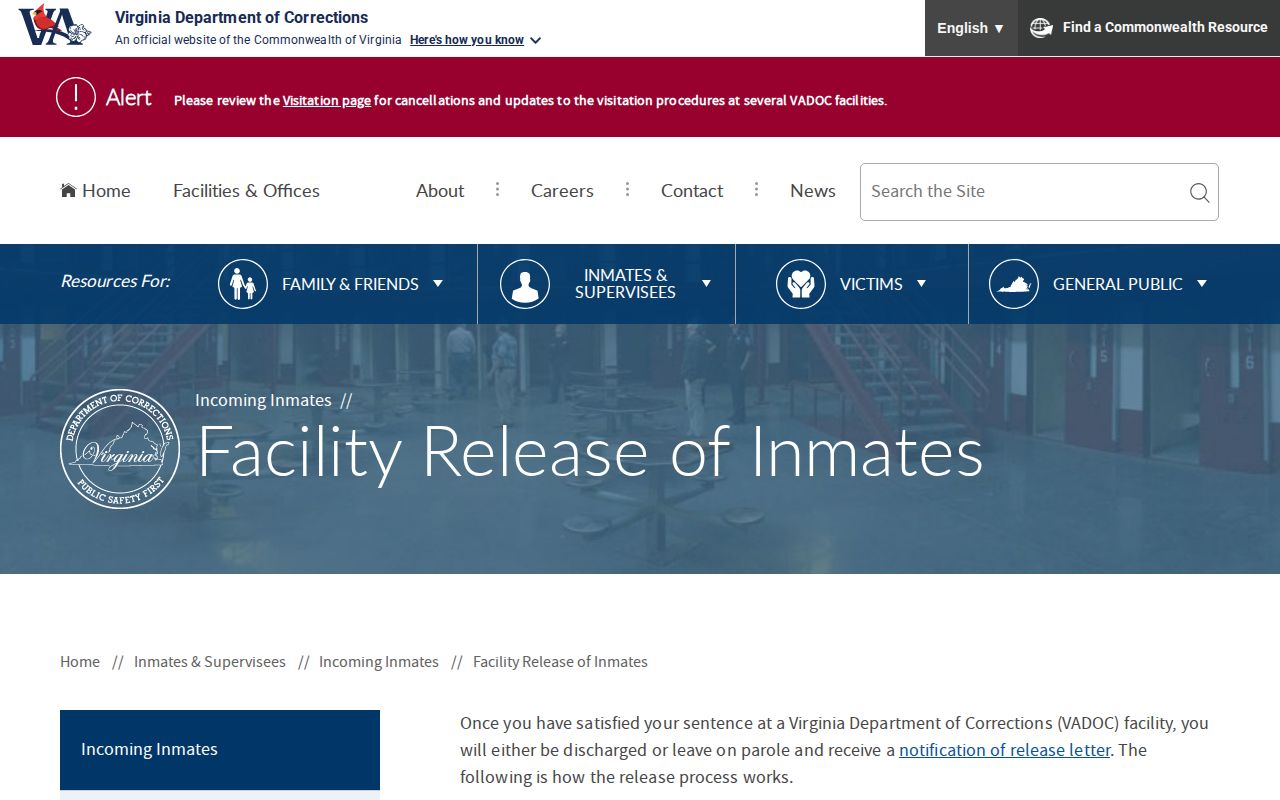
The state instructions help interpret a release date without turning it into a promise about travel, pickup, or the absence of another hold.
VADOC Projected Release Values
A person still confined may have an Estimated Release Date or another projected release-related value. Use the exact current interface label. It reflects sentence data and credits known to VADOC and can change after recalculation, court amendment, disciplinary credit loss or restoration, new sentences, detainers, or parole action. It is not a guaranteed gate date.
Virginia uses different credit systems based mainly on offense date and sentence. Good Conduct Allowance applies to older cohorts, while Earned Sentence Credits govern most later felonies. Current law sets different credit rates for different eligible offenses and conduct levels. The familiar statement that every Virginia prisoner serves 85 percent is not an individual rule. Prior NRVRJ jail credit, concurrent or consecutive terms, and court corrections can materially change the computation.
Never calculate a person's date by hand from a sentence alone. Ask VADOC time computation to review the displayed date and identify any missing order or jail-credit record. The request should use the full name and DOC ID, state the specific disputed value, and attach a relevant order when the requester is entitled to provide it.
VADOC Release and Supervision
Parole is conditional release from prison for an eligible sentence by decision of the Virginia Parole Board. Probation is court-ordered community supervision that can replace or follow custody. Post-release supervision can also attach to modern sentences without traditional discretionary parole. VADOC Community Corrections supervises these statuses, and Giles is assigned to District 16 in Wytheville.
A parole grant is not physical release. Applicable cases may require further processing before VADOC sets the release. Likewise, eligibility only allows consideration and does not compel a grant. Many post-1994 felonies are outside ordinary discretionary parole, subject to statutory exceptions. Use the Board decision, later VADOC status, and release document in sequence.
State-prison victim notifications use NAAVI, which is separate from local-jail VINE. The general public uses the VADOC locator. After actual release, VADOC custody notifications can end even while supervision continues through its own records and district contact.
Note: A Giles NRVRJ Release Date may mark transfer into VADOC, not the end of the state sentence.
Giles Credit and Court Records
Prior jail credit is central in a Giles state sentence. Time spent at NRVRJ before transfer or final sentencing may count toward the VADOC term under the governing commitment and computation. Counting only from arrival at a state prison can produce the wrong result. Concurrent sentences run together to the extent ordered, while consecutive sentences run one after another. The sentencing order and VADOC computation, not a casual calendar count, decide which term controls.
A detainer may leave the sentence-end date intact while changing the destination. VADOC can release the person from its authority directly to another agency. A new case, corrected order, escape or dead time, and disciplinary credit action can also alter a displayed projection. Request a computation review through the Correspondence Unit or Court and Legal Section when an order or jail-credit entry appears missing.
The Virginia Parole Board controls discretionary parole decisions for eligible cohorts, while VADOC implements release and supervision. A Board grant is not the gate event. Public meeting material does not list every eligible prisoner, and monthly decisions need later custody confirmation. Likewise, parole eligibility allows review but does not compel release.
Completed VADOC discharge can also outlast the public locator's active scope. When a former inmate no longer appears, use the Giles sentencing court, VADOC records, and any final supervision document. A missing entry is not itself a discharge certificate. Conversely, a community corrections location is a current affirmative status and should not be described as institutional custody.
Eligible victims use NAAVI for state-prison event notices. Virginia Jail VINE remains the channel for local and regional jails such as NRVRJ, and the two registrations do not automatically move between systems. The general public uses the locator. This split matters when a Giles person moves from regional jail to a state institution, because the source for custody information and notification changes with the custodian.
VADOC publishes its time-computation overview for the governing credit systems. Record access follows the VADOC FOIA route, while office assignments should be checked in the current facilities and offices directory.
Note: A supervisee locator result shows active community authority, not final discharge from the Virginia sentence or every other case.
Note: Prior NRVRJ jail credit can affect a VADOC computation, so do not count only from state-prison reception.