
Giles Projected and Actual Release
A projected release date is a calculation based on the sentence and information known to the custodian at that time. VADOC may describe a current prisoner's value as an Estimated Release Date, while its public-record procedure refers more broadly to projected parole eligibility, mandatory parole, and good-time release dates at the time of inquiry. Those labels are not interchangeable. Read the exact label displayed on the record.
An actual release occurs only after the responsible agency completes the release process and checks legal authority. For a Giles local case, that may be NRVRJ. For a state-responsible sentence, it is VADOC. A transfer can close one agency's custody without putting the person in the community. A detainer, new warrant, or order can send the person directly to another custodian.
Note: A pretrial defendant has no sentence-end date, so court action and bond status control the next possible release.
Find Giles Inmate Release Dates
Begin with the place that owns the sentence calculation. A person serving a short local term at New River Valley Regional Jail may never receive a VADOC locator record. A person transferred into state correctional custody belongs in the VADOC system even if NRVRJ shows a date that closed the local booking. The Giles court sentencing order supplies the legal term but ordinarily does not perform the jail's or VADOC's daily credit computation.
- Identify whether the person is pretrial, serving a local NRVRJ sentence, or serving a state-responsible VADOC sentence.
- For NRVRJ, search the official jail lookup with Include released inmates selected and call the jail for the local calculation or release record.
- For VADOC, search by the seven-digit DOC ID when possible, or use the required name fields and identity filters.
- Read the result's exact date label. Do not convert an estimate or parole-eligibility date into a promised release.
- Compare the sentencing order, prior jail credit, and later custody status when the value appears inconsistent.
- Confirm actual release through the custodian's record or direct response.
The Giles County released inmate search covers the complete local, state, court, and federal fallback chain after a person has already left custody.
Giles VADOC Release Date Scope
The VADOC Inmate and Supervisee Locator covers people in VADOC institutions, probationers and parolees under district supervision, certain hospital placements, local or regional jail prisoners under VADOC authority, and Community Corrections Alternative Program placements. Search requires at least the first three letters of the first name and the complete last name, or the seven-digit DOC ID. Optional filters include location, race, gender, and age.
VADOC says locator data updates daily and can be inaccurate or outdated. A state prisoner may have an Estimated Release Date. A person released to active VADOC supervision may remain searchable with a community status or district location. Someone who has fully discharged both custody and supervision may no longer appear. Thus, a locator result can establish present state status, while no result cannot certify a past release.
The official VADOC search interface pictured here shows the state search form and its data limitations.
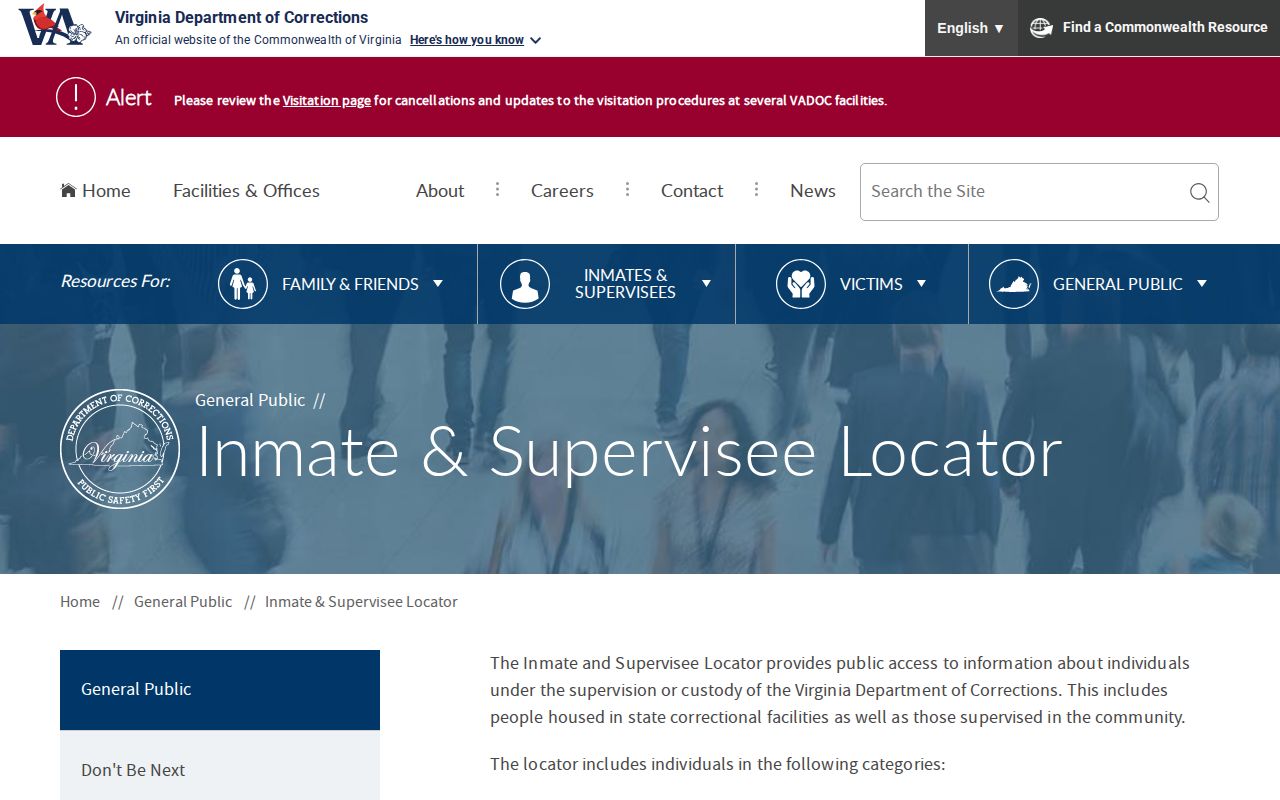
The form is the correct starting point for a state-responsible term, not for every person booked on a Giles charge.
Giles Earned Release Credits
Virginia uses different credit systems based mainly on offense date and sentence type. The VADOC time-computation overview distinguishes Good Conduct Allowance from Earned Sentence Credits. Good Conduct Allowance applies to older parole-eligible felonies committed before January 1, 1995 and older misdemeanors before July 1, 2008. Earned Sentence Credits govern most felony offenses committed on or after January 1, 1995.
Current Va. Code § 53.1-202.3 sets a maximum of 4.5 days credit per 30 days served for listed ESC-1 offenses. Other eligible ESC-2 offenses can earn at four levels: 15, 7.5, 3.5, or zero days per 30 served. Eligibility is governed by § 53.1-202.2, which has effective-date and version complexity. Under § 53.1-189, credits can be forfeited, and restoration rests with the VADOC director.
- Prior jail credit
- Qualifying time already spent in custody before sentencing or transfer.
- Earned Sentence Credit
- Credit earned under the modern statutory system for eligible felony terms.
- Good Conduct Allowance
- The class-based credit system used for specified older sentences.
- Forfeiture
- Loss of credit after qualifying misconduct or another authorized action.
Giles Truth-in-Sentencing Limits
The common “85 percent” phrase is only shorthand for part of Virginia's truth-in-sentencing design. At 4.5 credit days for each 30 served, 30 actual days plus 4.5 credit days satisfy 34.5 sentence days. That is about 86.96 percent actually served. Current law permits higher rates for some eligible non-enumerated offenses, so it is false to claim that every Virginia prisoner must serve exactly 85 percent.
Offense date, statutory eligibility, credit level, and conduct all matter. A public result cannot support a hand-calculated release promise without the full sentence and computation record. Use the displayed VADOC value, then ask for review if a known order or jail-credit award appears missing.
Note: Credit statutes define possible calculations, but only the custodian's current computation can state the projected date for one sentence.
Giles Prior Jail Credit
Time spent at NRVRJ before a Giles sentencing or VADOC transfer can be a major input. Counting only from the day VADOC received the person may produce a plainly wrong estimate because qualifying prior custody can be credited to the final sentence. The commitment record, sentencing order, and custodian's calculation establish whether the time was applied. A booking date by itself does not answer that legal question.
Multiple sentences make the review harder. Concurrent terms can overlap, while consecutive terms run one after another. A prior-credit award may apply under the controlling orders without moving every displayed milestone in the same way. Compare the court documents with VADOC's computation rather than adding days from the public record. If a credit award appears absent, identify that exact order in the review request.
Why Giles Release Dates Change
A projected date changes when an input changes or is corrected. That does not always mean an agency made an error. Sentence terms may run concurrently, at the same time, or consecutively, one after another. Prior jail credit may be added after a commitment record arrives. Credits may be earned, forfeited, or restored. A court can amend a sentence, and a new case can add custody authority.
| Factor | Possible effect | Best confirming source |
|---|---|---|
| Prior NRVRJ jail credit | Moves the computation when qualifying time is applied | Commitment, court order, and custodian calculation |
| Concurrent or consecutive terms | Changes which sentence controls the end date | Sentencing orders and VADOC computation |
| Credit loss or restoration | Moves an earned-credit date later or earlier | VADOC computation record |
| Court correction or new sentence | Changes the legal term or adds custody | Current court order |
| Detainer or hold | May change destination even when one term ends | Hold check and receiving agency record |
| Parole or conditional action | Creates a separate eligibility or release process | Parole Board decision and later VADOC release record |
Note: A detainer may leave the computed sentence date intact while changing the person's destination at release.
Giles Parole Dates Differ
A projected parole-eligibility date is not a parole grant. Eligibility only permits Board consideration. For older parole-eligible sentences, VADOC may calculate discretionary-parole eligibility, mandatory-parole release, and good-time release. Each answers a different question. Mandatory parole near sentence end is a distinct statutory path and may still include supervision.
Virginia abolished ordinary discretionary parole for most felonies committed on or after January 1, 1995, but current law has exceptions. It is unsafe to state that every modern prisoner lacks eligibility or that every older prisoner will receive parole. The offense date, statutory cohort, Board action, and VADOC release process must all align. Even a Board grant is not the physical departure date because VADOC still sets and processes release.
Review Giles Release Calculations
VADOC directs time-computation concerns through its Correspondence Unit and Court & Legal Section. A focused request should give the full name and DOC ID, identify the exact displayed or documented date, state which court order, prior jail credit, or sentence fact appears missing, and attach a copy when the requester is entitled to provide it. Ask for the computation record or correction route rather than asking public-facing staff to guess a new date.
VADOC Correspondence Unit / Court & Legal Section
P.O. Box 26963
Richmond, VA 23261
Administrative address: 6900 Atmore Drive, Richmond, Virginia
For a local NRVRJ term, request the jail's applicable written earned-credit policy and the releasable commitment or calculation. Va. Code § 53.1-116 requires a jail record and written earned-credit policy. No public Giles or NRVRJ individual computation sheet was located, so the calculation must not be invented from sentence length alone.
Giles VADOC Release-Day Process
The VADOC facility-release guidance supplies a state-specific endpoint. After a person satisfies a sentence at a VADOC facility, the person is discharged or leaves on parole by 11:59 p.m. on the date, weather permitting. The person reviews and signs release and supervision documents, receives property, and may receive arranged bus transport.
Those facts apply to VADOC facilities. They do not establish NRVRJ's release hour, and research found no published NRVRJ release time or weekend and holiday early-release rule. If a detainer exists, the usual property, funds, and transport process can differ because the person may go straight to another agency. Describe that event as release from VADOC or transfer, not return home, unless the destination is confirmed.
The official VADOC release page shown below documents the state discharge and parole steps.
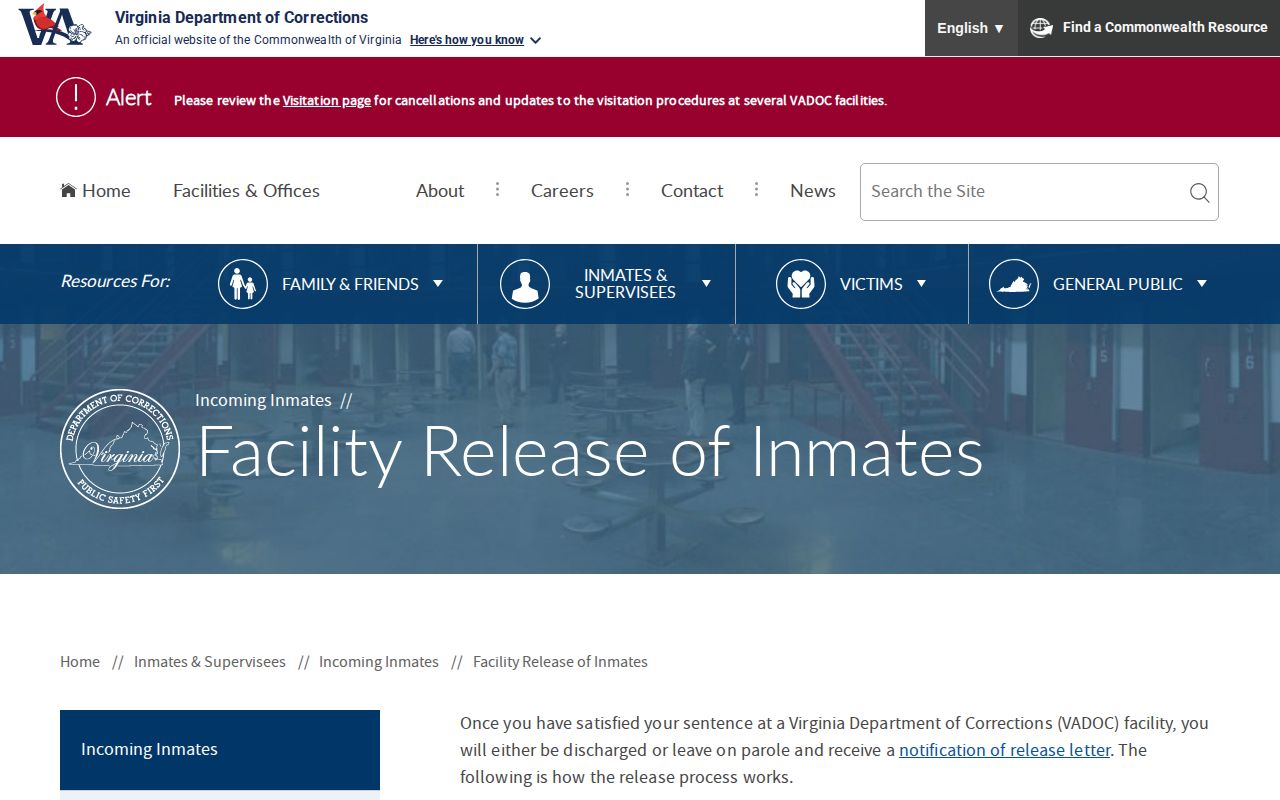
The state process turns a computed value into agency action, but the signed documents and later custody status remain the proof of what occurred.
Confirm Giles Actual Release Dates
For a local Giles case, NRVRJ's released-inmate search may display the Release Date, and the jail can provide direct confirmation or a release record. The Giles court case explains the bond, dismissal, sentence, revocation, or other legal authority, but it may not show the exact moment the doors opened. For a state case, use the VADOC locator, release letter or Order of Release, supervision documents, and final discharge record according to the question being asked.
Virginia Jail VINE can corroborate a local custody change, but a released-or-transferred message requires a destination check. Eligible state-prison victims use NAAVI, not Jail VINE. The Giles VINELink release check explains notification registration and the local-state split. A completed release should always be distinguished from a projected date, a parole vote, and a transfer to another custodian.
Note: Keep the date label with the record because eligibility, estimate, departure, and final discharge each prove a different stage.